


The Journal of Revolution and Liberation
Volume 1, Issue 3 (Oct 2018): "Into Freedom"
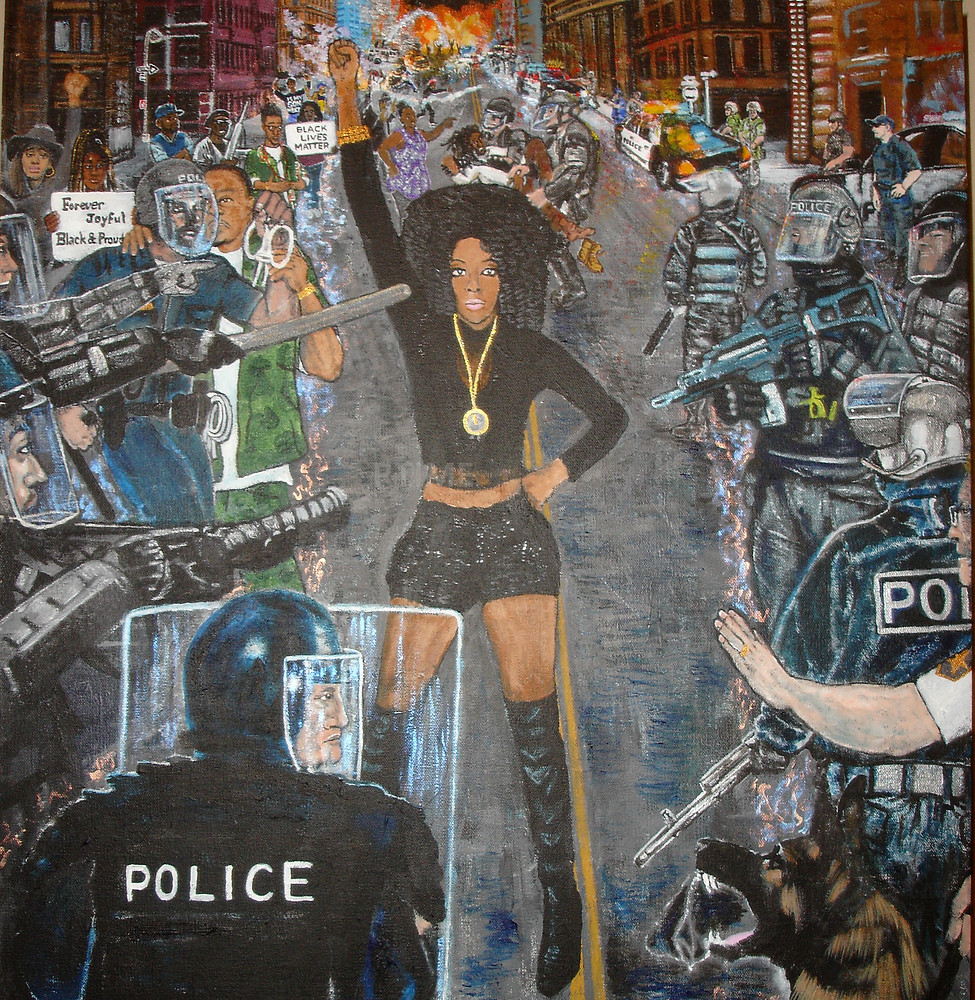
Cover Art: E-Volution by Leecasso

Journal of Revolution and Liberation
Volume 1, Issue 3(Oct 2018): "Into Freedom"

Table of Contents
1. JRevLib Issue 3 Editorial Summary
FLOW A: REFLECTION
2. "What Would Our Ancestors Say? A Reflection on Bahamian Emancipation Day", by Chris Davis
FLOW B: RE-CREATION
3. "Me the Caribbean Man", by Michael Pierre
FLOW C: RESISTANCE
5. Jariya: A Mini Art Collection, by Flo Beauredon
6. "Legalize It and I Will Analyze It", by Indira Martin
Editorial Summary: "Into Freedom"
In the Bahamas, there is an island called Eleuthera, which means ‘freedom’ in Greek. It was so named by the Eleutheran Adventurers, a group of pilgrims who in 1648 fled persecution in England to seek religious freedom on that loftily named island. But, the adventurers brought enslaved Africans to the ‘Freedom’ island: freedom for some was enslavement for others. In the last three months, Eleuthera has come to the fore of both national and international discourse, as Disney corporation has secured the purchase of what is perhaps the most pristine beach on the island, for use as a cruise ship port. Hopeful for employment opportunities, the locals (many of them descendants of those original enslaved Africans of Eleuthera), largely approved the Disney purchase, of their own 'free' will.
Also in this last quarter, in August, we celebrated the 185th anniversary of the Emancipation of enslaved Africans in Caribbean nations formerly colonised by the British. Despite this ‘emancipation’, forced apprenticeship continued for several years afterwards, and more than a century of colonisation and apartheid followed. In addition, to this day, a lack of economic independence throughout the African diaspora makes us prey for neocolonial interests (like Disney) as well as for large economies (such as the US, EU and China) and global economic structures (such as IMF/World Bank and WTO). Pressed with these Realities, we must truly ask, Are We yet Free?
During the same period, we have watched the valiant struggle of Bobi Wine (Robert Kyagulanyi) in Uganda, persecuted for his opposition to the political status quo. In his recent song ‘Freedom’ he says ‘What is the purpose of liberation when we can’t have a peaceful transition…freedom fighters become dictators, they look pon the youth and say we distractors’. This phenomenon of a New Generation coming forward to challenge the entrenched and ageing postcolonial political leadership is being seen elsewhere in the diaspora, where political independence has failed to transition successfully into economic independence, an indication of the reality that We are not yet Free.
JRevLib Issue 3- ‘Into Freedom’ includes a brilliant and bold analysis of race relations in the Bahamas, in which revolutionary legal and race scholar Dion Hanna delivers a sobering prognosis of the state of race relations in Bahamas, in the context of the global history of racism. In this, he shows that both Black and White Bahamians are afflicted with ‘historical amnesia and cognitive dissonance’ that can only be solved by indigenous analysis of race matters, socio-economic empowerment of the Black majority and a redefinition of the Black Bahamian identity.
The theme of cognitive dissonance is continued in ‘Me the Caribbean Man’ by Michael Pierre of Trinidad and Tobago; in this emotive piece we feel the struggle of claiming an identity in the context of the Caribbean where there has been a constant assault on the African cultural identity. The author ends by saying he is ‘now christened a new entity’. This concept of the power of self-creation is also confidently explored in ‘Birth’ by Arvis Mortimer in which she asserts that ‘in whatever moment I choose, I can become a new me’. Both these pieces are reminiscent of Franz Fanon, who has said, ‘In the World through which I travel, I am endlessly creating myself’.
A beautiful art series by Flo Beauredon from France via Atlanta, USA starkly counterposes the sad history of slavery in ‘Silent Scars’, as well as the continuation of brutality against people of colour in the present-day in ‘Jariya (Resistance)’, against our hopes and dreams of peace, freedom and serenity, in ‘She said PEACE’ and ‘Freedom Dancer’. We are called to close this yawning gap between our aspirations and our Reality.
So, how do we progress ‘Into Freedom’? In the video submission ‘Legalize it and I will analyze it’, Indira Martin proposes the legalization of cannabis as a means of actualizing greater economic and scientific independence in the Caribbean. Additionally, in a continuation of Beauredon’s ‘Jariya’ theme, an excellent article on Bahamian emancipation by historian Chris Davis highlights the key means by which Africans in the Bahamas and wider diaspora have historically progressed ever deeper ‘Into freedom’: through active Resistance.
Indeed, this concept of Resistance emanates from the striking Issue 3 cover art, ‘E-volution’, by Leecasso of California, USA, which depicts a lone woman in the chaos of the white supremacist prison-industrial complex, raising her fist defiantly to the sky. This image communicates the core tenet of JRevLib Issue 3: that we will go forward ‘Into Freedom’ no matter the obstacles, and we will do so because it is the Human imperative.
Therefore, in the name of the Ancestors, and motivated by the Hopes and Dreams of our Descendants yet unborn, We must PUSH ‘Into Freedom’. We Must break the chains of mental slavery. We Must Create and Re-create. We Must Reclaim. And in the face of oppression, We Must Resist.


What Would Our Ancestors Say? A Reflection on Bahamian Emancipation Day
By: Christopher Davis
Christopher is a Bahamian historian and researcher and co-founder of Afrikan Ebube, a pan-African educational forum
Summary:
What would the ancestors think about our commemoration of Emancipation Day in the modern Bahamas? This article outlines the struggles of Africans in the Bahamas, and their resistance to enslavement, as a challenge to the fallacious Eurocentric 'Wilberforce' narrative offered as historical (mis)truth. A cogent argument is put forward for a re-framing of the emancipation narrative to celebrate and remember the endurance of the Ancestors.
On August 1st, 1838 chattel slavery ended in the Bahamas and most of the British 'colonies.' Often when speaking about emancipation, the focus is on people like William Wilberforce, Thomas Clarkson and even Queen Victoria. They are often presented as allconquering heroes who are almost solely responsible for the end of slavery in the British Empire. The official Abolitionist movements coming out of Britain as well as the pioneers of the Industrial Revolution are also sometimes portrayed as the only major driving-forces of emancipation. Many of the British Abolitionist movements were somewhat disingenuous, though more progressive than their counterparts still overtly racist. This is usually coupled with depictions of enslaved black people begging and pleading, whose only hope for freedom rested on solely the efforts of white parliamentarians, philanthropists and clergymen. The rhetoric of many British abolitionist movements usually stopped short of perpetuating any real social equality and retribution after dealing with the removal of chattel slavery. However, this could not be further from the truth. People like Olaudah Equiano, Mary Prince and Ignatius Sancho were put in the forefront and galvanized the abolitionist movements but often still treated as second class citizens within the groups. In the film Amazing Grace, Wilberforce is highlighted while Equiano is reduced to minor role with a few lines and cameos. We have martyrs, heroes, heroines and people who possessed the sense of divine fearlessness who are also the movers and shakers of British Emancipation and in a broader context even more so.

Black emancipation was truly pushed and carried through by the enslaved themselves, while white abolitionist only debated and signed documents in an ivory tower. Africans throughout the diaspora were constantly fighting against their enslavement in a variety of ways to differing results. The unknown enslaved girl in the most desolate corner of the Bahamas during slavery who feigned sickness or ran away even for a day; causing her enslaver the most meager of economic loss; has contributed vastly more to the ending of slavery than any British dignitary who has never experienced chattel slavery. Every action, no matter how large or small, contributed to the fact that not only was slavery unjust, unethical and evil but it was also dangerous for the colonizer and enslaver. These acts against slavery on every level made the institution unstable from within, and were crucial in realization that the notion of ‘perpetual’ slavery is impossible.
In paraphrasing Historian Bayyinah Bello, “resistance to slavery didn't start in Britain and/or France but on the first slave ships, where the first enslaved Africans fought for their freedom." Within the global African Diaspora, we are encouraged to make heroes of those who are not only outside of our own communities but directly benefited from the indescribable horrors our ancestors and kinsman endured. Our two most prominent statues, Christopher Columbus and Queen Victoria are obvious illustrations of this part of our neo-colonial indoctrination. Another blaring example was unveiled weeks ago; The Statue of Woodes Rogers, our first colonial governor who helped strengthen the British Slave Trade before being propagandized as the man who put an end to Bahamian piracy and “restoring commerce”.

The Bahamas has also played its own unique role leading up to British Emancipation. Below are just three broad major factors leading up to Emancipation and how the Bahamas contributed:
RESISTANCE BY THE ENSLAVED:
The role of the enslaved and other blacks was central in the push for emancipation. The Haitian Revolution, Maroons of Jamaica and Guyana, African Kingdoms of Brazil and Colombia and many other revolts and acts of 'divine fearlessness' resonated through the minds of the major beneficiaries of slavery and opponents of slavery alike. By the early 1800s, the enslaved created a real rational fear of African people one day rising up and not only freeing themselves but turning the ingrained social hierarchy upside down. The concept of the Bahamian Saltwater Underground railroad falls into this category. There are 29 documented slave ships where enslaved people were freed and settled in places like Adelaide, Gambier and the various ‘Freetowns’ and ‘Congo Towns’ on Family Islands. The people who came off of these ships were generally referred to as Liberated Africans. The way our industrious mariners have historically exploited other ships is well documented but revolutionary acts against slavery are rarely mentioned. Settlements like Red Bays, Andros were peopled by Seminoles who were escaping enslavement and genocide in Florida in the early 1800s. They were brought there by “bold captains of sloops from the British Bahamas who offered transportation across the Gulf Stream.” Even the great Olaudah Equiano was shipwrecked in the Bahamas and rescued right in time by Bahamian mariners and brought to Nassau.


In the Bahamas, virtually every island had forms of resistance to varying degrees. In Long Island 1809, Monday, Abram & Neptune Pratt murdered their notoriously cruel overseer Andrew Holmes on Thomas Pratt's plantation. They were summarily executed and Neptune’s body was put on display as a warning to other would be rebels. The enslaved of the Johnson Plantation in Eleuthera and Fergusons in Exuma boycotted for better conditions on the plantation in 1833. The demographics of Abaco are partially reflective of the Black Loyalists who held their ground on the mainland, fighting and refusing to re-enslaved. This made it more difficult for white loyalist to establish slavery on parts mainland Abaco. This is well documented in recent the recent works of Dr. Christopher Curry, Bahamian Historian; himself a direct descendant of Abaconian Loyalists. Dr. John Henrik Clarke states that "every country in the Americas had Maroon societies without exception." There were maroon societies at various times during Bahamian Slavery at Blue Hills with the death of a leader Indian John in 1786 and the infamous Jem Matthews (early 19th century) identified as the major leader throughout the following decades. They refused to be enslaved or to conform to racial societal norms and chose to live in as much autonomy as could possible in the Bahamas’ unique environment. Uniquely, Negro Town (present day Bain & Grants Town) was viewed as a place as unsafe for whites until colonial governors officially brought it into the societal fold; a pseudo Petit Maroon society right over the hill “behind the hospital” or “south-west of Government House.” Throughout the 1780s to the early 19th century this bastion of black autonomy was seemingly controlled by Black Loyalists who established churches and friendly societies in the area that stand to this day. Junkanoo is based upon an Akan General in present day Ghana who fought against the British and Dutch control of slave trading forts for years; Quamino, who planned to take over the Bahamas and possibly sail to Africa, may well have been among John Canoe's Lieutenants enslaved by the British after decades of fighting.


Dick Deveaux and his family of Golden Grove, Cat Island (1831) and the French Negros led by Bethune Lockhart (1797) risked it all in the name of basic human rights and freedom. The revolt on the ship “The Creole” was most successful slave revolt in United States history but took place entirely in the Bahamas. Just east of Abaco the slaves led by Madison Washington and Elijah Morris mutinied and took the ship and sailed it to Nassau after learning that Liberia was too far. Morris sparked the revolt by lowering the unsuspecting first mate below deck and fired the last shot of the mutiny. Bahamian mariners encircled the ship and prevented the Americans from retaking it and sailing on to Cuba. This incident resulted in the freedom of over 140 slaves with only two of them dying. Elijah Morris remained in the Bahamas with his wife Nancy Barton and they settled in Gambier where he participated in the liberating of other Africans and Creoles from slave ships. Some of his descendants reside in Gambier to this day. It is alleged that first time Morris met his wife-to-be, was when he helped liberate her from slavery, something that happened among several couples onboard the ship. Pompey and the Rolle slaves were almost in a constant state of resistance in the years leading up to emancipation. Through ingenious boycotts, the Rolles in Exuma were called the "most disagreeable" during the apprenticeship period and the former owners where happy to part with the land after receiving compensation; absolutely nothing to do with any notion of benevolent slave masters as we were sometimes led to believe. Literally thousands of Bahamians share kinship with these historic people, with ‘Rolle’ still the most prevalent surname in the Bahamas. Many of these stories resonated on both sides of the slavery argument at home and abroad.


REPORTED INCIDENTS OF CRUELTY
In the early 19th century, reports of cruelty to slaves were being more soundly documented and many came from the Bahamas. In fact, there was rarely an A Monthly Anti- Slavery Reporter without the Bahamas mentioned in it. The Bahamas was famous for excess cruelty toward female slaves, often times involving Assembly members and influential business men within the community. Mother and daughter Shelah and Florah Dames spent their early years raking salt on Long Cay and Little Exuma with their children. Henry Adderley had a reputation for cruelty and was exposed when Florah revealed in secret to the Governor J.C. Smyth that her mother had miscarried because she had been punished in the workhouse. Adderley attempted to sell them away to avoid getting a slap on the wrist and to punish their resilience. In a story with a bitter sweet end, the family ended up together back with their original ’owner’ but in little Exuma as salt-rakers. This was one incident of many that appears in the “Governor’s Despatches” through James Carmichael Smyth’s tumultuous tenure.

Pompey's Revolt was magnified upon realization by the enslaved that several of their women were severely beaten, two of them were with child. These acts of cruelty were overseen by Robert Duncombe and John Anderson who were long time assembly members and among the most influential men in the Bahamas at the time. In 1831, Alick Farquharson thoroughly beat James Farquharson with a metal bludgeon. James was the mulatto son and overseer of Charles Farquharson in San Salvador, with a reputation for having his way with the women on the plantation. Alick bludgeoned James in response to the whipping of a young family member for mounting a mule on the wrong side. The conflict between the two had strong undertones of an anomalous love triangle and magnified by Alick consistently referring to James as ‘Jim’ (slaves were required to address their superiors with master, sir, mister etc). John Wildgoose found himself under scrutiny of Governor Smyth. He had ordered two severe floggings of a slave named Phoebe. The second flogging claimed the Governor could not have been for any reason because it happened while still confined for the first; and couldn’t possibly have committed an offence to warrant the second. (There was also a rule for allowing lashes to heal enacted several years earlier). In the early 1830s, Ben Moss was given the cruelest sending off by his would be former enslaver within the last hour before his manumission. This was carried out by Henry and Helen Moss, a married couple in Crooked Island who were infamy extended far beyond Bahamian shores.


The most powerful and influential cases in the Bahamas that influenced widespread emancipation was the story of 'Poor Black Kate.' In 1826 on Henry and Helen Moss' plantation in Crooked Island, a young slave names Kate was murdered. Kate would have found herself in an unbearable situation, from a domestic slave to raking salt for hours a day with her chastity perpetually at risk. The Anti-Slavery Monthly Reporter mentioned her in almost every issue since late 1826. Entitled "Cruelties Perpetrated by Henry and Helen Moss, On a Female Slave in The Bahamas.” Defiant every step of the way, this martyr of the African Diaspora endured everything from severe floggings, over work in the field (she was originally a domestic) spending weeks in a sweat box and rubbing pepper in her eyes to prevent her from sleeping. She finally died while working in the field and the ensuing court case ended with a proverbial slap on the wrist. However, her story was always referred to concerning on cruelty of slaves and was central in pushing towards amelioration acts particularly the flogging of female slaves throughout the British slave-states. In every case without exception, the perpetrators of these cruelties received resounding support by the Bahamian white and planter class. Even the infamous Moss’ character was vigorously defended and anger was boldly expressed at the fact that they were been punished at all.


AFRICAN/BLACK LITERARY CONTRIBUTIONS
There is a long list of formerly enslaved people whose narratives galvanized all modes of movements towards emancipation. Two of the most significant ones are Olaudah Equiano and Mary Prince both of whom have connections to the Bahamas. Even from beyond the grave, Olaudah Equiano was the true driving force behind the abolitionist movement. Eqiuano purchased his freedom in 1766 after making money as a jack of all trades and was very fortunate to have a more humane enslaver. His writings were deeply influential to Wilberforce on a personal level. Equiano tirelessly toured and taught Britain and brought the harsh realities of slavery to the doorsteps of pro and anti-slavery voices alike. He was kidnapped in Africa and sold into slavery with a Portuguese name forced on him: Gustava Vassa. He was a member of a strong abolitionist group called Sons of Africa, and the narrative of his life was one of the convincing documents in Britain abolishing the slave trade in 1807. His story still resonates today and he represents a truly powerful rags to riches story comparable to Frederick Douglass and Robert Smalls. Amazingly, he was on a vessel travelling to Georgia that capsized in the Bahamas. They sought refuge on a very desolate island and just as all hope was lost they were discovered and brought to Nassau. If Bahamian Mariners didn’t save his life, the world may only have been graced with a small portion of his talents. He is a pioneering figure in literature, politics and especially abolition on a global scale. Indeed, if a sole award for influencing British emancipation in 1838 was to be given one person, it would undoubtedly have to be Olaudah Equiano. Born in African, he experienced kidnapping, the march to the coast, slave dungeons, the middle passage and slavery in varied scenarios. He also resisted slavery as a slave, an author and probably more so from the grave while the contemporary history books have consistently given William Wilberforce and Thomas Clarkson almost the majority of the credit.


Mary Prince's autobiography gives sound examples of the harsh realities on the Bahamian Salt plantation and unequivocally dispels the myth of slavery being milder/easier in the Bahamas. Enslaved in the U.S.A., Antiqua, England and the Bahamas, here most difficult and traumatic experience was on a typical Salt plantation in the Bahamas, a seasonal commodity produced on every Bahamian Island. Crooked Island, Acklins, Inagua, Little Exuma, Ragged Island, Long Cay and the entirety of the Turks and Caicos were all islands whose economies were dependent on the raking of salt. The cruelty that Mary Prince received witnessed was so bad that it is alleged that it soften the hearts of the most avid pro-slavery voices. She greatly influenced global abolitionist movements, pointing at her experience on Grand Turks being the worst period of her life as a slave. She wrote "History of Mary Prince" which arguably became one of the most influential factors during the push for British Emancipation and was the first written by a black woman in Britain. Prince became one of the most influential people in the world at the time. In unapologetic fashion, she lamented "I have been a slave myself—I know what slaves feel—I can tell by myself what other slaves feel, and by what they have told me. The man that says slaves be quite happy in slavery—that they don't want to be free—that man is either ignorant or a lying person. I never heard a slave say so. I never heard a Buckra (white) man say so, till I heard tell of it in England." After a very public and victorious legal battle with an influential nemesis, little is known about the remaining years of her life. It is believed she may have left the spotlight for her own safety. Another theory is she may have been kidnapped and/or murdered and never heard from again as theorized in with African American Narrative writer Solomon Northup.


CONCLUSION
Today, for most Bahamians of all walks of life Emancipation Day has become like any typical holiday where we are only happy for the long weekend. Of all countries with a similar demographic and history (In the context of British colonialism) the Bahamas has among the least ceremonious emancipation celebrations. There seems to be a great divide crated between our enslaved ancestors, our shared glorious, complex and painful history and Black Bahamians who are alive today. The Ethiopian African Black International Congress has always held the prestigious holiday in the highest honor, with lively annual marches; all too often very poorly attended. Gambier Day is another official celebration, also perpetually poorly attended. Surely if the black Diaspora knew of its historical significant Americans may also develop a profound appreciation and travel to celebrate emancipation with us. Even Black Point Exuma and Cat Island, two vanguards of Black Bahamian Revolutionary action and strongholds, host their Regatta’s when the holiday is celebrated with theme of Emancipation on the backburner. Of course, we are not do not share the brunt of the blame but in recent times have perpetuated the great disconnect between ourselves and our ancestors. We are constantly bombarded with procolonial propaganda and African/Black Bahamian History has been a dormant volcano for far too long. Many Bahamians justifiably possess the name ‘Wilberforce’ in commemoration of emancipation but you cannot find a single one named after Olaudah. As a nation, we have consistently failed to truly commemorate those that fought, died and endured so that we can live and breathe today.
We can proudly say that our ancestors literally and figuratively built the ‘New World’ for others to enjoy and lay the foundations of the strongest economies in the world today. Emancipation Day is a day for celebration, so there is nothing wrong with having fun on the holiday. However, let us not lose sight of the true meaning of this precious day; so meaningful to the entire African Diaspora whether we choose to acknowledge it or not. Emancipation Day should celebrate not only our ‘Blackness’ but our strength and historically superior humanity. We must do better in commemorating and showing love for our ancestors as they would us as their great-great-great grandchildren. On Emancipation Day, we must show appreciation for our ancestors who endured, without whom none of us would be alive today.


Me The Caribbean Man
By Michael Pierre
Michael shared a womb for 7 months and was born in 1988 in Trinidad and Tobago. His interests are art, music and writing mostly for himself. He has been described as a free spirit and water-loving.
Summary
'Me The Caribbean Man' highlights some of my experiences and the stories told to me by others in a condensed format; touching ethnic and racial divides and history. It is my hope that debate and frustration comes from this piece. Debate and frustration can lead to constructive solutions which forges change. How can we overcome? Note a solution is not given because just like the interpretation it is up to the reader to investigate, discover and share solutions; The Start To The Great Conversation and The Beginning of Healing.
How does one define the classical Caribbean Man?
The Caribbean man is a demonstrative product of forgery that is, somewhat close to the real thing; counterfeit but useful. This is the definition passed from lips to ears and encoded in genes, illustrated as phenotype. We nurtured fields with our lives, now our roots grow strong. We were displaced from our homes; being told the land belongs to a queen unseen in a language unknown. We were the messengers who laboured through battles with the sea seeking sovereignty, expanding our scape and the monarch’s empire. The Caribbean man is complex. Complexity not built from interconnected simple pathways but complexity entangled in complexity. How do we decode the Caribbean man?
What are the results of the Caribbean Man; language, music and self-expression?
When compared to West Africans we are similar but yet counterfeit. Indians; we are not Indian enough. And in the white man lands, we are black despite the lack of our melanin. The Caribbean man is new and emerging. Creators through discretion; hiding to worship Gods of the old, disguised in the realm of Catholicism, even drums penetrate through the sombre rituals of the church. We learning of a God that loves us and pray to Gods to protect us. Being bred to create perfect specimens which were robbed of knowing their fathers. Birthed in chaos but “civility” is expected. We were killed by touch even by breath, bodies confused by foreign entities and babies told you were raged-filled cannibals. Breeding self-fear and self-hatred, the mental and genetic trap placed and its potency unquestionable. Now blessings turn to curses, my ancestors reaped rewards and never considered the consequences of their actions, now I must hide from those who were enslaved, trapped but now free and those freeing others - I quake because now I must suffer.
Is the Caribbean Man diseased?
The future holds retaliation and war. Lands reclaimed, shackles free and unknown enslavers exposed and forced to see the light and understanding terribly instilled. And all those who checked Others in the box for so many years along with the first, the free, the counterfeit, the newly enlightened, the fighters of war and the silent well-wishers even those who don’t give a f**k can just say I am definitively Caribbean.
We are pidgined,
Limitless and the face futurism.
Formless and abundant in diversity
Where ancestors congregate and the counterfeit is now christened a new entity.

Birth
By Arvis Mortimer
Arvis is a public health professional from The Bahamas
Summary:
Birth is a poem that expresses one of the author’s fundamental beliefs, that individuals (particularly able-minded persons) are inherently agents of their lives and can be the directors of their destiny. It is hoped that the key themes of personal power, potential and possibility are easily identified and it is recognized that even though one’s body may be relegated to a specific location, or a particular state, transcendence beyond limiting self-perceptions, self-definitions, or even the internalization of external judgements is possible. It is the goal of the writer that each reader knows that, though not always easy, new and empowering attitudes can be adopted – contributing to revolution and liberation within; which can lead to the same without.
Let me tell you a secret
I have been born more than once
Through the portal between
The world and my mother’s womb
I entered fairly unannounced
Newly released with a novel start
This was my first birth
But it was not my last
For
Like you
I was endowed
With power and creativity
So in whatever moment I choose
I can become a new me
I have permission to change course
I do not have to remain the same
I can blossom into something different
I can even rewrite my name
I have the liberty to escape
Any self-imposed pain
I can embrace my singularity
And choose those with whom I would want to hang
Birthdays do happen
Many times in one day
Because when I need a restart
I can be as when I first came
Fresh, free and purely me.
Jariya: A Mini Collection
By: Flo Beauredon
Originally from France, and currently residing in Atlanta, Georgia, Flo has a passion for Freedom of expression and honesty, as well as being kind to one another, and always defends the causes of the disadvantaged ones. Combining themes of awareness, symbolism of hidden truths and using her paintbrushes as a whistle blower at times, her paintings are raw and symbolic.
Summary:
JARIYA is a piece representing the oppression of the Black Man through centuries (1700’s – 2000’s) Jariya means “Resistance” in Hausa language (most spoken language in West Africa). This painful history is also reflected in the second piece, 'Silent Scars', and following this, out of a historical collage of struggle and resistance we see a lone woman emerging with a message of peace in 'SHE SAID PEACE'. The series ends with 'Freedom dancer', which evokes a sense of serenity, an objective to be claimed in the chaotic horror of white supremacy.


Jariya
Silent Scars
She Said PEACE
Freedom Dancer
Legalize It and I Will Analyze it
By: Indira Martin
Indira is a biomedical scientist based in Nassau, Bahamas
Summary:
Marijuana (scientific name cannabis) has been used medicinally for thousands of years, throughout the world. In recent years, following decades of prohibition, there has been renewed interest in medicinal cannabis, and a surge of research and increased liberalization of the cannabis plant in North America and Europe. Despite prohibition, The Caribbean has historically played a pioneering role in medicinal cannabis research and use. Therefore this video argues for the full liberalization of cannabis in the Caribbean, to enable Caribbean scientists to contribute to the rapidly emerging global research into biomedical cannabis use, thereby catalyzing a Biomedical Revolution in the Caribbean.
Cognitive Dissonance and Historical Amnesia: Racism and Race in a Bahamian Context
By: Dion Hanna
Dion Bahamian legal scholar, lecturer, researcher and community activist based in the UK.
“I plucked my soul out of its secret place, And held it to the mirror of my eye, To see it like a star against the sky, A twitching body quivering in space, A spark of passion shining on my face. And I explored it to determine why
This awful key to my infinity Conspires to rob me of sweet joy and grace. And if the sign may not be fully read, If I can comprehend but not control, I need not gloom my days with futile dread, Because I see a part and not the whole. Contemplating the strange, I’m comforted By this narcotic thought: I know my soul.” Claude McKay 1
It has been asserted that the concept of race has always been a vital component in the shaping of Bahamian history and national identity.2 In this regard, as we are advised by Nettleford in respect of Jamaica, but equally relevant to the Bahamas, race is more than “yeast for dough” in the social fabric of Bahamian society3. Further, Adrian Gibson has indicated that locally, although the “unambiguous and overt forms of racism” may have receded since Majority Rule and constitutional changes, in the political realm, clearly race continues to be a relevant feature of political rhetoric. He further indicates that the concept of race has “greatly shaped our society and national identity” and that its structure provides us with a “framework to address issues that may linger and persist in dividing our nation”4. Nevertheless, as we are reminded by Curry, unfortunately, in The Bahamas very little has been written directly concerning racism since independence5.
1 Claude McKay and William J. Maxwell (2008): Complete Poems of Claude McKay. Urbana, Ill, University of Illinois Press
2 Christopher Curry (2018): “Race Relations in the Post-Independence Bahamas” In The Journal of
Revolution and Liberation, Vol. 1 (2) July
3 Rex Nettleford, (2007): “Prologue: The Caribbean and Cultural Studies: More than Grimace and Colour” In Brian Meeks (ed.) Culture, Politics, Race and Diaspora: The Thought of Stuart Hall. Kingston and London. Ian Randle and Lawrence and Wishart.
4 Adrian Gibson (2010): “Is the Bahamas Mature Enough to Vote for a White Political Leader” In The Tribune, November
5 Christopher Curry (2018) supra.
However, it is important that we place our discourse in the context of the ambivalence of Bahamian national identity6. As we are reminded by Stuart Hall, we must bear in mind postmodernism's deep and ambivalent fascination with difference, including sexual difference, cultural difference, racial difference and above all, ethnic difference.7 Further, it has been indicated that the “project of identity”, whether individual or collective, is rooted in desires and aspirations that cannot be fulfilled, identity movements are “open ended, productive and fraughtwith ambivalence”.8 In this frame of reference, it is important to consider Christopher Curry's indication that even though Bahamians use the term race in vernacular discourse, the term is problematic,9 and has been described as being a “prickly subject”.10 In this regard, it is critical to bear in mind that the concept of race is an artificial construct created in the late 18th and 19th centuries, but part of a gradual process that began in the advent of the so called voyage of discovery of Christopher Columbus in 1492. Its invention was inspired by the need to justify European colonial domination and enslavement of Black people in the Americas, Africa and Asia.11 Columbus began the process by the demonization of the Caribs, creating a false image of them as cannibals and by his stereotyping of the Taino people as a people in need of the civilizing influence of western Christianity and fit for enslavement to exploit gold, pearls and other natural resources12.
5 Christopher Curry (2018) supra.
6 Arthur Dion Hanna jr. (2011): Decoding Fault Lines of Life and the Enigma of Being: Immigration
Policies and the Formation of National Identity in the Caribbean. Paper Presented to the International Bar Association's Rule of Law Seminar - The Rule of Law: Immigration Policies in
the Caribbean. Hilton Hotel, No.1 Bay Street, Nassau, The Bahamas, 25th February; (2014): Distant
Echoes Of Pan African Identity: The Discordant Resonance Of Cultural Resistance And Ambivalence Of Identity In A Diasporan Context. Paper Presented to the 43rd Annual Conference of the British Society for Eighteenth Century Studies, St Hughes College, Oxford University: 8-10 January
7 Stuart Hall (1992: 23): “What is This 'Black' in Black Popular Culture?” In Gina Dent (ed.) The Center for the Arts, Dimensions in Contemporary Culture, No. 8: Black Popular Culture. Seattle. Bay Press
8 James Clifford (2000:95): “Taking Identity Politics Seriously: The Contradictory Stony Ground” In Paul Gilroy,+Lawrence Grossberg and Angela McRobbie (eds.) London. Verso Press
9 Ibid.
10 Adrian Gibson (2010) supra.
11 Eric Eustace Williams (1964): British Historians and the West Indies. Brooklyn N.Y. A& B Books; George Boulukos (2008): The Grateful Slave: The Emergence of Race in Eighteenth Century British and American Culture. Cambridge, Cambridge University Press; David Olusoga (2015): “The Roots of European Racism Lie in the Slave Trade, Colonialism and Edward long” In The Guardian 8 September
12 Basil Davidson (1992): “Columbus: The Blood and Bones of Racism” In Race and Class Vol.33 No.3, 17-25; Jan Carew (1994): Rape of Paradise: Columbus and the Birth of Racism in the Americas. Brooklyn. N.Y., A&B Books; R. Carew(2006): The Rape of Paradise: Columbus and the Origins of Racism in Americas. Astoria, N.Y, Seaburn Publishing Group
European xenophobia and racial othering was manifest in the expulsion of Moors and Jews in Spain in 1609 and the expulsion of “Blackamores” by Queen Elizabeth I in England in 1598.13 Early on, the Spanish began a process of racial classification, othering and demonising non-White peoples. This was catalyzed by the fact that, in the aftermath of their conquest of the Americas, the early colonists, who were soldiers from Iberia, began, from the 15th century, to have sexual relations with Native Americans, and subsequently, with Black African slaves. By the 17th century, the widespread race mixing became a concern for the Spanish monarch and racial purists in Spain. This led to a pyramid of race differentiation that became known as 'castas', with the White race being at the apex and Black Africans at the base of this racial paradigm. In a series of paintings known as 'Las
Castas', to explain this complex division of humanity, Spanish artists were commissioned to graphically portray the essence of this racial pyramid14. This racial paradigm, was a means of political and social control and determined status in society. At the top of the racial pyramid were those of pure Spanish blood born in Spain; just beneath them were those of pure blooded descent born in the Americas, known as Crillos. Under this umbrella of White supremacy were the Native American People and in descending order Mestizos, who were a mixture of Spanish and Native American; Castizos who were a mixture of Mestizos and Spaniards; Cholos a mixture of Native American and Mestizos; Pardos, a mixture of Spanish, Native American and Black African; Mulattos, a mixture of Spanish and Black African; Zambos, a mixture of Native American and Black African, with Negros, pure blooded African people at the base of the racial and social pyramid15.
13 Peter Fryer (1984): Staying Power: The History of Black People in Britain Since 1504. Atlantic Highlands N.J., Humanities Press; Emily C. Bartels (2006): “Too Many Blackamoors: Deportations, Discrimination and Elizabeth I” In Studies in English Literature, 1500-1900, March
14 David Cahill (1994): “Colour by Numbers: Racial and Ethnic Categories in the Viceroyalty of Peru” In Journal of Latin American Studies, Vol. 26. Available online: <https://web.archive.org/web/20131029200024/http://people.cohums.ohiostate.edu/ahern1/SpanishH680/secure/Cahill%20-%20colour%20by%20numbers%2C%2012%20pages.pdf> ; MariaElena Martinez (2000): “Space Order and Group Identities in a Spanish Colonial Town: Puebla de los Angeles” In Luis Roniger and Tamara Herzog (eds.) The Collective and the Public in Latin America: Cultural Identities and Political Order. Brighton, UK/Portland Oregon, Sussex Academic Press; (2004): “The Black Blood of New Spain: Limpieza de Sangre, racial Violence and Gendered Power in Early Colonial Mexico” In William and Mary Quarterly, 3rd edn. Vol. LXI July; Sarah Cline (2015): “Guadalupe and Casatas: The Power of a Singular Colonial Mexican Painting” In Mexican Studies, Vol. 31 (2); Rebecca Earle (2016): “The Pleasures of Taxonomy: Casta Painting Classification and Colonialism” In the William and Mary Quarterly Vol. 73 (2) July
15 Ibid.
Elsewhere in 18th century Europe, European biologists and physicians, such as Carl Linnaeus16, Charles White17, Benjamin Rush 18 and Cristoph Meiners19, began to classify humanity into separate races in a pyramid which placed White people at the top, as the superior race and Black people at the base, as being inherently inferior. However, it is in the wake of Darwin’s social theories
expounded in his book The Origin of the Species20, in the 19th century that biological theories were developed to provide a scientific basis for racial difference. Scientific racism was developed by philosophers and scientists such as the French aristocrat Arthur de Gobineau21, who advanced the concept of three races, White, Black and Yellow and argued that race mixing would lead to the collapse of culture and civilization. His racist theories asserted that the White race originally possessed a monopoly of beauty, intelligence and strength and were inherently superior. His theories were highly influential with slaveholders in the Americas and more recently with the Nazi Party in Germany22.
16 Heinz Goerke (1973): Linnaeus. New York, Scribner; Norman J. Sauer (1993): Applied Anthropology and the Concept of Race: A Legacy of Linnaeus” In Annals of Anthropological Practice, Vol. 13 (1) January; Theodor Magnus Fries and Benjamin Davidson Jackson (2011): Linnaeus. Cambridge, Cambridge University Press
17 Charles White and Samuel Thomas Soemmering (1799): An Account of the Regular Gradation of Man and in Different Animals and Vegetables. London, Literary and Philosophical Society of Manchester; John P. Jackson and Nadien M. Weidman (2010): Race, Racism and Science: Social Impact and Interaction. New Brunswick, NJ, Rutgers University Press
18 Benjamin Rush (1786): An Oration: Delivered Before the American Philosophical Society, Held in Philadelphia of the 27 February 1786[ Containing and Inquiry Into the Influence of Physical Causes Upon the Moral Faculty by Benjamin Rush, Md and Professor in Chemistry, University of Pennsylvania; Benjamin Rush and Dagobert D. Runes (2013): The selected Writings of Benjamin Rush. New York, Philosophical Library
19 Michael C. Carhart (2007): The Science of Culture in Enlightenment Germany. Cambridge, Mass. Harvard University Press; Nicholas Bancel , Thomas David and (Dominic Richard David Thomas (2014): New York, Routledge; Christopher Meiners (2018): History of the Female Sex, Vol. 1 and 2. (Classic Reprint) Forgotten Books
20 Charles Darwin (2009): The Origin of the Species by Means of Natural Selection or the Preservation of Favoured Races in the Struggle for Life. New York, Modern Library
21 Arthur de Gobineau (1971): Selected Political Writings. Michael D. Biddiss ed., London, Cape; (2009): The Inequality of Races. La Vergene, General Books
22 Paul Fortier (1988): “Gobineau and German Racism” In Comparative Literature, Vol. 19; Michael D. Biddiss (1971): Father of Racist Ideology: The Social and Political Thought of Count Gobineau. Littlehampton Book Services Ltd.
Others, such as the Dutch scholar, Pieter Camper23, the American physician Samuel George Morton24 posed pseudo-scientific theories of craniometry involving measurement of interior skull volume to justify racial differences. Subsequently, Social Darwinists, such as Herbert Spencer developed theories around the concept of eugenics, which emphasized the survival of the fittest, that was premised on the advancement of the superior White race through domination of the weaker races. This theory was used to justify domination of the upper class over the lower class, colonizer over colonized and the enslavement of Black African peoples25. These so called scientific theories developed on a foundation based on the myth of racial purity and ignored the historical reality of race mixing since the dawn of time26. Despite a modern day persistence of scientific theories of White racial superiority27, these crude and erroneous representations of the concept of race and racial difference have long been discredited28. However, it would be a mistake to assume that the social construct of race is some “mental quirk or psychological flaw”29. They are not “fragments of a demented imagination” but are central to the economics, politics and culture.30 Further, it has been pointed out that race has been integral to how languages have been defined over time and that language has been central to how race has been theorized and expressed in scholarship, “particularly in the western modern era”31.
23 Robert Paul Willem Visser and R. P. W. Visser (1985): The Zoological Work of Pieter Camper1722-1789. Amsterdam, Rodopi; David Bindman (2002): Ape to Apollo: Aesthetics and the Idea of Race.. ithica, NY, Cornell University Press
24 Samuel George Morton (1949): Catalogue of Skulls of Man and the Inferior Animals in the Collection of Samuel George Morton. Philadelphia, Merrihew and Thompson; (2012): Crania Americana: Or a Comparative View of Various Aboriginal Nations of North and South America, to Which is Prefixed an Essay on the Varieties of the Human Species. (Reprint). London, Forgotten Books
25 David Duncan (1908): The Life and Letters of David Spencer. New York, D. Appleton & Co.; Herbert Spenser and David Duncan (1996): Collected Writings, Vol. 2: The Life and Letters of Herbert Spencer. London, Routledge/Theommes Press
26 Thomas C. Holt (2004): “”Understanding he Problematic of Race Through Problem of Race Mixture” Paper Presented at the Interdisciplinary Conference “Race and Human Variation: Setting an Agenda for Future Research and Education, September 12-14, 2004 in Alexandria, Virginia. Available Online http://www.understandingrace.org/resources/pdf/myth_reality/holt.pdf; J. A. Rogers (2011): Sex and Race: Negro and Caucasian Mixing in All Ages in All Lands, Vol.1 The Old World. St Petersburg, Florida; Helga Rogers 27 William Shockley and Roger Pearson (1992): Shockley on Eugenics and Race: The Application of Science in the
Solution of Human problems. Scott-Townsend
28 Robert Wald Sussman (2014): The Myth of race: The Troubling Persistence of an Unscientific idea. Cambridge, Mass., Harvard University Press
29 Franz Fanon (1952): Black Skins, White Masks. New York. Grove Press; (1961): The Wretched of the Earth. New York. Grove Press
30 Robert Blauner (2001): Still the Big News: Racial Oppression in America. Philadelphia, temple University Press
31 Anne H, Charity Hudley, Christine Mallinson and Mary Bucholz et. al. (2018): “Linguistics and race: An Interdisciplinary Approach Towards an LSA Statement on Race” In Proc Ling Soc Amer 3. 8:1-14
It has been indicated that conflicting models of classification have been used and that linguists have not developed a “cohesive theory or model of race”32. Hudley, Mallinson and Bucholz et. al. assert that linguists and others still struggle with “models of racial classification” which tend to capture the “tension of racialization” between, on the one hand “racial classification and attribution that are prescribed to a person and group” and on the other, “racial classifications that individuals or groups ascribe to themselves” with significant challenges being posed by researchers trying to examine and define “linguistic systems of cultures that they themselves do not participate in”33. This underscores the fact that it is the White western academic world that has created and engaged the language of race34 and that the issue of identity is rooted in the academic discourse of the late 18th and 19th centuries by scholars such as Descartes35, Locke36, Kant37, Hegel38, and Durkheim39. The evolution of language to describe racial identity has been a constant process and has always been a consequence of the definition of the other by the White western world. In the 16th century, the term Negro was adapted in English linguistics to describe people of Black African origins and its use continued into the 1960s40. The Term Coloured has its roots in South Africa to describe persons of mixed racial descent41 but in the United States and subsequently in the United kingdom, the term Colored was developed to describe non-White peoples during the Jim Crow era42.
32 Ibid.
33 Ibid.
34 Robert V. Guthrie (2004): Even the Rat Was White: A Historical View of Psychology. Boston, Allyn Bacon; John R. Rickford (2014): Increasing the Representation of Under-Represented Ethnic Minorities in Linguistics. Paper Presented as part of the Symposium : Diversity in Linguistics at the Linguistic Society of America Annual Meeting, Minneapolis Minnesota, January 2014; Linguistic Society of America (2015): Annual Report: The State of Linguistics in Higher Education. Available Online <https://www.linguisticsociety.org/resource/state-linguistics-higher-education-annual- report>
35 Rene Descartes (1983): Principles of Philosophy. V. R. Miller and R. P. Dordrecht (trans.) (eds.). Reidel; (1998): The World and Other Writings. Stephen Gaukroger (trans.) (ed.) Cambridge, Cambridge University Press
36 John Locke and Edmond Law (1777): The Works of John Locke. London, W Strachan
37 Immanuel Kant (1969): Foundations of the Metaphysics of Morals. Lewis White Beck (trans.) Indianapolis, Bobbs-Merrill; Manfred Keuhn (2001): Kant: A Biography. Cambridge, Cambridge University Press
38 Herbert Marcuse (2000): Reason and Revolution: Hegel and the Rise of Social Revolution. London, Routledge Georg Wilhelm Friedrich Hegel (2002): Philosophy of Nature Vol. 3. London. Routledge; Georg Wilhelm Freidrich Hegel (2018): The Phenomenology of Spirit. Cambridge, Cambridge University Press
39 Emile Durkheim, Kenneth Thompson and Margaret A. Thompson (2006): readings From Emile Durkheim. London, Routledge; Emile Durkheim (2013): Emile Durkheim on Institutional Analysis. Chicago, University of Chicago Press
40 Tom W. Smith (1992): “Changing Racial Labels: From Coloured to Negro to Black to African American” In Public Opinion Quarterly 56(4) 496-514
41 S. A. Tishkoff, F. A. Reed and and F.R. Friedlaender et. al. (2009): “The Genetic Structure and History of Africans and African Americans” In Science Vol. 324, 1036-44; E. Delport de Wit, W. Ragamika and C.A. Mientjes et. al. (2010): “Genome-Wide Analysis of the Structure of the South African Coloured Population i Western Cape” In Human Genetics 128(2) 245-53; Juliette Bridgette Milner-Thornton (2012): The Long Shadow of the British Empire: The Ongoing Legacies of Race and Class in Zambia. Palgrave and Macmillan 42 Nicholas Deakin, Brian Cohen and Julia McNeal (1970): Colour, Citizenship and British Society: based on the Institute of Race Relations Reports. Panther Books; Henry Louis Gates jr. (1995): Colored: A Memoir. Vintage; (2012):“Growing Up Colored” In American Heritage Magazine Vol. 62(2) Summer
The term Black was used to describe dark skinned people and was utilized by Samuel Morton in his categorization of races into a divinely based hierarchy with White European people at the top and Black Ethiopians at the bottom43. At onetime, the term was considered insulting but in the late 1960s it was embraced by the African community in America and globally and used widely in the anticolonial liberation struggle and resonated in the call for Black power44 and expressed in James Brown's song '”Say it Loud I am Black and I am Proud”45. In the 1980s and 1990s in Britain the term was adopted the African Caribbean and the Asian communities as a political sense in the struggle for empowerment and antiracism46. People of color was used primarily in the United States, and more recently in Britain, to denote all non White people to emphasize the common experiences of systemic racial discrimination47. The term Asian in Britain has been utilized to describe people from South East Asia, primarily India, Pakistan, Bangladesh and Sri Lanka.The term Ethnic Minority was developed in England and the United States by sociologists to describe people of a particular ethnic group, race or nationality, living in a country where the majority population is of a different ethnic group, race or nationality48.
43 Samuel George Morton (1849): Catalogue of Skulls of man and the Inferior Animals in the Collection of Samuel George Morton. Philadelphia, Marrihew and Thompson; Iyiola Solanke (2018): “The Stigma of Being Black in Britain”.In Identities Vol. 25 (1)
44 George Breitman (1967):”In Defence of Black Power” In International Socialist Review, January-February; Stokeley Carmichael and Charles V. Hamilton (1967): Black Power: The Politics of Liberation in America. New York, Vintage Books; Scot Brown (2003): Fighting for Us: Maulana Karenga, the US Organization and Black Cultural Nationalism. New York New York University Press; Jeffrey O. G. Ogbar (2004): Black Power, Radical Politics and African American Identity. Baltimore, John Hopkins University Press
45 James Brown Say it Loud I'm Black and I'm Proud {Album 1969) King Records
46 Tariq Modood (1994): “Political Blackness and British Asians” In Sociology, Vol 28 (4) November
47 Yo Jackson (2006): Encyclopedia of Multicultural Psychology. Seven Oaks CA, Sage; Alvin N. Alvarez and Helen A. Neville (2016): The Cost of Racism to People of Color: Contextualizing Experiences of Discrimination. Washington DC, American Psychological Association
48 L. Worth (1945): “The Problem of Minority Groups” In Ralph Linton (ed.) The Science of Man in World Crisis. New York, Columbia University Press; Gad Barzilai (2010): Communities and Law: Politics and Cultures of Legal Identities. Ann Arbor, University of Michigan Press; Timothy Laurie and Rimi Khan (2017): “The Concept of Minority for the Study of Culture” In Continuum: Journal of Media and Cultural Studies Vol. 31 (1)
More recently, the term BME (Black Minority Ethnic) has been utilized by sociologists to refer to non White communities initially in the United States where it was used to extend the discussion of rights beyond the term African Americans49 and subsequently adapted in Britain50. It has been argued that this label should be dismissed as being “illogical, othering and counterproductive”51 and in a UK context it has been indicated that it is not “dissimilar to categorizations used to justify
“horrendous acts of segregation in the past (and current)”52. The invention of derogatory terms to describe Black People and Asians such as Nigger, Wog, Paki, and Nig Nog are still used by racists although not a widely as in the 19th and 20th centuries. Similar abusive language has been used to describe the offspring of mating between the races such as Mulatto (same as an infertile Mule which is a product of the mating of a horse and donkey) Mestizo (Dog) half caste (someone less than whole). Despite the fact that the biological classification of races developed in the 18th and 19th centuries have long been discredited, the language of race underscores the fact that the racist paradigm continues and that the social phenomena of race and racism remains as a central feature of western societies. The fact that the western academic community continues to define racial groupings and categories, underscores the survival of the essence of White privilege. This confirms Dr Francis Cress Welsing's contention that racism is a “universal operating system” of white supremacy and domination in which the “majority of the world’s white people participate”.53 This poses a conundrum and paradox in the context of forging racial identity, in that Black people are “enslaved by a complex of inferiority”, while White people are “enslaved by superiority”, with both behaving and acting in accordance with a “neurotic orientation”.54
49 Editor (2018): “Comment: The Poverty of Labels – Why We Should Dismiss the 'BME' Label as Illogica, Othering and Counter Productive”” In the Beaver, January 25
50 A. Memon, K. Taylor and L. M. Mohebati et. al. (2016): “Perceived Barriers to Accessing Mental Health Services Among Black and Minority Ethnic (BME) Communities: A Qualitative Study in South-East England” In BMI Open. Available Online <https://bmjopen.bmj.com/content/bmjopen/6/11/e012337.full.pdf>; Mark Brown (2018): “BME People Severely Under represented in Top English Arts Bodies” In The Guardian Monday 15 January
51 Editor (2018) infra.
52 Ibid.
53 Frances Cress Welsing (2004): The Isis (Yssis) Papers: The Keys to the Colors. Washington D.C., C W Publishing
54 Frantz Fanon (1952) supra.
As pointed out by Stuart Hall, identities are points of “temporary attachments” to the “subject positions which discursive practices construct for us”55. In this respect, identities are markers of traditional categories utilized in western social sciences, including race, ethnicity, gender, nationality and social class. Race invariably interacts with other social phenomena, including gender56, class57, ethnicity58 and age59, ever evolving in form and is amoeba like, shape shifting
and often creating new and hybrid forms invisible to Western academia and officialdom60. In this regard, concepts of race and racism have evolved throughout the 20th century and into the 21st century.
55 Stuart Hall (1996): “Introduction: Who Needs Identity” In Stuart Hall and P. DuGay (eds.) Questions of Cultural Identity. London, Sage
56 Philomena Essed (1991): Understanding Everyday Racism: An Interdisciplinary Discipline. Sage; Sally Haslanger (2000): “Gender and race: (What) Are They and (What) Do We Want Them to Be?” In Nous 34(1) 31-55; Sapana Pradham-Malla (2005): “Racism and Gebder” In Dimensions of Racism: Proceedings of a Workshop to Commemorate the End of the United Nations’ Third Decade to Combat Racism and Racial Discrimination. Paris, 19-20 February 2003, New York and Geneva, Office of the High Commissioner for Human Rights (OHCR) and United Nations Educational, Social and Cultural organization (UNESCO); Shaminda Takhar (2016): Gender and Race Matter: Global Perspectives on Being a Woman (Advances in Gender Research, Vol. 21, Emerald Group ltd
57 Raymond S. Franklin (1991): Shadows of Race and Class. Minneapolis, University of Minnesota Press; Earl Ofari Hutchinson (1995): Blacks and Reds: Race and Class in Conflict, 1919-1990. East Lansing, Michigan State University Press; Paul Gilroy (1991): There Ain’t no Black in the Union Jack: The Cultural politics of Race and Class. Chicago, University of Chicago Press; Paul C. Mocombe (2014): Race and Class Distinctions Within Black Communities: A Racial Caste in Class. New York Routledge; Gail Dines and Jean M. Humez (2018): Gender, Race and Class in the Media. Los Angeles, Sage; Akala (2018): Natives, Race and Class in the Ruins of Empire. London,
Two Roads
58 Grant Jarvis (1991): Sport, Racism and Ethnicity. Routledge Falmer; Colin Kidd (1999): Charles Kaye and terry Linguish (2000): Race, Culture and Ethnicity in Secure Psychiatric Practice: Working With Difference. London/Philadelphia, Jessica Kingsley Pub.; Peter Osborne and Stella Sanford (2002): Philosophies of Race and Ethnicity. London, Continuum; Yasmin Hussain (2005): Writing Diaspora: Souh Asian Women, Culture and Ethnicity. Aldershot Hants/Burlington Vt, Ashgate Aldershot Hants/Burlington Vt, Ashgate
59 R. Travis Osborne, Clyde E. Noble and Nathaniel Weyl et. al. (1978): Human Variation: The bio psychology of Age, Race and Sex. New York, Academic Press; Graham Richards (1997): Race, Racism and Psychology: Towards a Reflexive History. London/New York, Routledge; James Y. Nazroo (2003): “The Structuring of Ethnic Inequalities in health: Economic Position, Racial Discrimination and racism” In American journal of Public Health, 93 (2) February, 277-284; Pat Thane (2010): “Unequal Britain: Equalities in Britain Since 1945” In History & PolicyMarch. Available Online http://www.historyandpolicy.org/policy-papers/papers/unequal-britain-equalities-in-britain-since-1945; Equality and Human Rights Commission (2013): Putting Equality and Human Rights at the Centre of the Care Support Reform. London, EHRC
60 Gargi Bhattacharyya (2009): Ethnicities and Values in a Changing World. Farnham UK/Burlington Vt, Ashgate; James C. Peterson (2010): Changing Human Nature: Ecology, Ethics, Genes and God. Grand Rapids, Mich, Eerdmans Pub Co.; Arthur Hanna (2011): Land and Freedom – A Return to the Fishing Village: Sabbatical Essays of a Legal Aid Lawyer. USA, Createspace/Karadira Blackstar; Nazila Ghanea (2012): The Concept of Racist hate Speech and its Evolution Over Time. Paper presented to the United Nations Committee on the Elimination of Racial Discrimination’s Day of Thematic Discussion on Racist Hate Speech, 81st Session, 28 August 2012, Geneva.
Available Online https://www.ohchr.org/Documents/HRBodies/CERD/Discussions/Racisthatespeech/NazilaGhanea.pdf; Lindy
Orthia, Emma Rhys and Holly Rose et. al. (2013): Dr Who and Race. Bristol/Chicago, Intellect; Pnina werbner and Tariq Madood (2016): Debating Cultural Hybridity: Multi-Cultural Identities and the Politics oof Anti-Racism. London, 2nd Books
In order to see what is going on we need to engage a multidisciplinary intersectional analysis61. Hence we can define racism as a social construct of prejudice, discrimination, hostility and antagonism developed in the late 18th and 19th centuries by Europeans based on the hierarchical stratification of races and reinforced by the historical processes of colonialism, imperialism and the dynamic of White power and privilege. It operates on the assumption of White biological, cultural, economic and political racial superiority. It is also a social phenomenon that is dynamically constantly evolving and operating on individual, structural and institutional levels, constantly interacting with other social phenomena such as class, gender religion and ethnicity, being amoeba like, constantly changing form and substance and often creating new and hybrid manifestations unrecognised by the official legal system and western academics. It is a debilitating process which dehumanizes, marginalizes and dis-empowers and under-develops Black and other non White peoples and privileges White patriarchal western society. Racism is manifest in the daily everyday lived experiences of Black and other non White peoples. In a Bahamian context, as I have indicated elsewhere, it is essential that we be guided by historical specificity and deviating from traditional Western scholarship, essentialize and contextualize the daily lived experiences of ordinary everyday Caribbean peoples, taking full account of their plural and multicultural realities62. In this regard, Nettleford indicates that in their “self doubt and lack of confidence”, too many Caribbean people still tend to follow what the North Atlantic has done.63
61 Humanities at Stanford (2010): “Changing Perceptions of Race and Ethnicity” In Examining Conversations About Race With a Multidisciplinary Scope. Available Online <http://shc.stanford.edu/news/research/examining-conversations-about-race-multidisciplinary-scope>; Andrea Romei and Salvatore Ruggieri (2013): “A Multidisciplinary Survey of Discrimination Analysis” In The Knowledge Engineering Review Vol. 00:0, 1-54; Dean E. Mundy (2016): “Bridging the Divide: A Multidisciplinary Analysis of Diversity Research and the Implication for Public Relations” In Research Journal of the Institute of Public Relations, Vol.3(1) August. Available Online < https://prjournal.instituteforpr.org/wp- content/uploads/Dean-Mundy-1-1.pdf>; David R. Roediger and Donald M. Shaffer (eds.) (2016): The Construction of Whiteness: An Interdisciplinary Analysis of Race Formation and the Meaning of White identity. USA, University Press of Mississippi
62 Arthur Dion Hanna jr. (2013): Forging Critical Legal Analysis In Clinical Legal Education: A Multicultural Caribbean Perspective On Legal Education In The 21st Century. Paper Presented to the 2013 Law Schools' Teaching Effectiveness Conference: ‘Toward an Empirical Approach to Teaching Legal Education' Jamaica Pegasus Hotel, Kingston, March 22, 2013
63 Rex Nettleford, “Prologue: The Caribbean and Cultural Studies: More Than Grimace and Colour” In Brian Meeks (ed.) Culture, Politics, Race and Diaspora: The Thought of Stuart Hall. Kingston and London. Ian Randle and Lawrence and Wishart. (2007:7)
Further, as I have asserted, in the social, political, economic, spatial and cultural dimensions of the legal landscape of the Caribbean, a complex interaction between race, class and gender mandates that we conduct our analysis from a multidisciplinary frame of reference, centred on the lived experiences of ordinary, everyday Caribbean people.64 It has been indicated that n the 18th century, prior to the arrival of the loyalists, the Bahamas Islands was a closed society dominated by a White male minority, which was a “common practice in the English portion of the Western hemisphere”65. However, Johnson indicates that, economically, Free Black people and persons of colour could legally own personal and real property, including slaves, and engage in economic activities although they were barred from selling liquor and had restrictions placed on trading and planting66. However, the arrival of the Loyalists, particularly from East Florida drastically changed the racial dynamic. In this regard, it has been pointed out that the relatively high percentage of White people in the Bahamas, its proximity to the United States, with its segregation practices, and close cultural ties to the United States, along with a weak Black middle class, “made for more antagonistic race relations in the Bahamas”67. Further, Curry points out that, historically, the Bahamas presents a unique model of race relations, incorporating elements of both West Indian and Southern United States systems68. He indicates that:
“The West Indian model, institutionalized during slavery, created a tripartite system with a distinct middle class comprised of coloreds who operated as a buffer between the elite White class and the laboring black masses. The colored middle classes, although the progenitors of White and black sexual liaisons, were rejected by Whites due to their colour while envied by the enslaved because of their freedom. In The Bahamas, evidence of the tripartite racial model was seen in all aspects of the colonies social, economic and political spheres. Hence, in recreational and social activities, coloreds in The Bahamas emulated the White minority in order to distance themselves from the black masses and gain respectability or even acceptance by Whites”69.
64 Arthur Dion Hanna jr. (2013) supra.. C/F Philomena Essed, Understanding Everyday Racism: An Interdisciplinary Theory. Amsterdam. Sage Publications. (1991); Arthur Dion Hanna Jr., The Two Faces of Justice: Racism in the English Criminal Justice System. Unpublished Masters Dissertation. University of London (1994); Sorry I Can't Come Out to Play: Report of the Mary Seacole Racial Harassment Project on Racial Harassment and Attacks on the St. Matthews Estate. Leicester, Leicestershire. Leicester Racial Equality Council and Mary Seacole Racial Harassment Project. (1994); The Bahamian Appeals Process: Fractured Neo Colonial Reflections of Imperial Justice and the Development of Caribbean Jurisprudence in the 21st Century. Paper Presented to the National Bar Association Mid-Winter Meeting. Sheraton Nassau Beach Resort, Nassau Bahamas, 14 February (2013)
65 Whittington Bernard Johnson (2000): Race Relations in the Bahamas 17884-1815: The Non-Violent Transformation From a Slave to a Free Society. Fayetteville, University of Arkansas Press
66 Ibid.
67 Gail Saunders (2007): “The Race Card and the Rise to Power of the Progressive Liberal Party in the Bahamas” In the Journal of Caribbean History, Vol 41 (1⁄2) January
68 Christopher Curry (2018) supra.
69 Ibid.
Palmer points out that these “refugees” from the Southern United States not only supported slavery but they also preferred to remain loyal to the United Kingdom. The racial divisions engendered by the presence of these 'loyalists” in those early years, laid the foundation for the social organization and stratification of contemporary Bahamian society.70 Under the race paradigm engendered by the Loyalists, Black slaves were virtually powerless and could be bought or sold at “the masters' discretion” and because of the rigid colour bar, Free Black people were restricted from full participation in the society and economy of the islands.71 The segregated spatial dimensions of the Bahamian racial paradigm defined the stratified nature of Bahamian society, which was quite evident in the Out Islands (Family Islands) of the Bahamas, where segregated communities were developed, with all White settlements in Spanish Wells, Man-O-War Cay and Abaco, all Black settlements in Long Cay, Rum Cay, Cat Island, Mayaguana and Andros, and
bi-racial settlements in Green Turtle Cay and Harbour Island.72
70 Catherine Palmer (1994): “Tourism and Colonialism: The Experience of the Bahamas” In Annals of Tourism Research, Vol. 21 (4)
71 Dean W. Collinwood (1989 a): The Bahamas Between Worlds. Decatur, Illinois, White Sand Press; (1989b): “The Bahamas in Social Transition” In Dean W. Collinwood and Steve Dodge (eds.) Modern Bahamian Society, Parkersburg,IA, Caribbean Books; L. D. Powels (1996): Land of the Pink Pearl: Recollections on Life in the Bahamas. Nassau Bahamas, Media Pub
72 Christine Palmer (1994) supra.
Palmer indicates that slavery was widespread and all Black people, free or slave, were subject to discrimination and racial prejudice, even after emancipation in 1838.73 As pointed out by Collinwood and Dodge: “Though the Blacks were no longer slaves, they were effectively barred from important roles in the English colonial administration and from lucrative economic pursuits. The Blacks were denied full citizenship rights and were exploited by the White autocracy”.74
Despite the historical legacy of racial differentiation and prejudice and the ongoing spatial, economic and social dimensions of the race phenomenon, much of the modern popular discourse on race has been characterized by a propensity to deny the essence of the enduring legacy of race in Bahamian society. Such historical amnesia and cognitive dissonance is clearly demonstrated in comments made in a letter to the Editor in the Nassau Guardian when the writer stated that the history of the Progressive Liberal Party's perennial usage of the race card to woo Black Bahamian voters to the political party and that “since the 1950s have pitted Black Bahamians Against White Bahamians”75. Further, the writer asserts that an accusation that all White Bahamians are racist is the “oldest play from the playbook of the PLP”76 and that this helped to “unseat” the ruling UBP in January of 1967. He further asserts that it was used throughout the “lengthy reign” of the late Sir Lynden Pindling to “frighten Black Bahamians” away from the FNM which had amalgamated with elements of the disbanded UBP old guard. The anonymous writer writing under the pseudonym 'Whistle Blower' concludes that whatever racial issues 'plagued' the Bahamas during the 1950s and 1960s, they are virtually non-existent today in the 21st century77. Such sentiments fly in the face of the social realities engendered by the historical colonial oligarchical social pyramid of racial differentiation. It is myopic to assume that the attainment of majority political rule in 1967 in the Bahamas somehow became a panacea for magically ending the deeply rooted phenomenology of race or racism endemic to Bahamian society.
73 Ibid.
74 Dean W. Collinwood and Steve Dodge (es.) (1989): Modern Bahamian Society. Parkersburg, IA., Caribbean Books
75 Nassau Guardian, May 23, 2012
76 Ibid.
77 Ibid.
Further, the notion that Black people have become racists is misguided and betrays an absolute failure to comprehend the essence of race and racism explored in this paper. By definition, the Black Bahamian community can never be considered racists, given the power dynamic of the Bahamian racial paradigm, with 15% of the Bahamian population which is White, controlling 85% of national resources, with the majority of Black Bahamians being landless and disempowered.
Palmer points out that, during the middle part of the 20th century, the White so called Bay Street Boys, who controlled the Bahamas, were a clique of wealthy merchants and lawyers with shops or offices on Bay Street She indicates that years of colonial rule served to strengthen the control of the “White minority elite”, as the members of the “colonial administration” were elected from this group.78 Palmer concludes that the “privileged status” of the White population is aptly stated in the following comments of a Black Bahamian: “At certain times, the Black population couldn't go to certain places, specifically on Nassau, because it was off limits to them. I've heard this said by a lot of elderly people, that during the British rule, a lot of Whites took advantage in terms of 'getting' favours. If you were White you could get land, you could get a loan at the bank. That's how Whites
in this country really got their money, because of favours”79.
It is quite clear that, despite the White oligarchy losing its stranglehold on political power in 1967, they continued to hold a virtual monopoly control of Bahamian land and natural resources.80 As a result of the historical process of racial subjugation and exploitation in the colonial process, enforced by the oligarchical control of the Bahamian economy, Black Bahamians have been, in the main, excluded from the “historical, social and technical transformations” that were taking place in the rest of the World.81
78 Catherine Palmer (1994) supra.; C/f Michael Craton and Gail Saunders (1999): A History of the Bahamas. Waterloo, Ont., San Salvador Press; Gail Saunders (2017):Race and Class in the Colonial Bahamas. Gainesville, University Press of Florida
79 Ibid.
80 Arthur Dion Hanna Jr. (2011) Land and Freedom: One Bahamas and a Tale of Two Cities. Paper Presented to the Bahamas Historical Association, 7th April, Nassau, Bahamas. Available online <http://www.academia.edu/12349576/Lans-and_Freedon-Onr_Bahamas_and_a_Tale_of_Two_Cities>
81 Albert Memmi (1990): The Colonizer and the Colonized. London, Easthscan; Catherine Palmer (1994): supra.
Similar cognitive dissonance and historical amnesia is revealed in comments of Larry Smith when he argued that: “Not surprisingly, it took well over a generation for Bahamians of both races (and those in-between) to even begin to come to terms with the changes wrought in 1967. For Blacks, centuries of slavery, exclusion \and second class citizenship had given way overnight to supreme political power, whereas Whites had seen their peculiar vision of Bahamian crashed overnight”82. Smith further contends that, “unfortunately the recent commemoration of January10 as 'Majority Rule day' is little more than crass PLP posturing” and that as Sir Arthur Foulkes noted, Bahamians of “all political and racial groups contributed to the democratic achievement of 1967”.83 He contends that after decades of being berated, humiliated and sidelined for the “sins of the past”, most White Bahamians have:
“Quietly disengaged from society, a fact which Black Bahamians are, ironically, quick to exploit.....For us to believe that we can fuse together One Bahamas in 30 years is a pipe dream. Indeed only Black Bahamians want this, Whites do not. If White Bahamians make up less than 15% of the population but control 85% of the wealth, then obviously, Black Bahamians still feel that White is right and the lighter the better. That is the social psychology of racism in the Bahamas. It seems that despite the passage of time and the obvious transformation of our society to the point where Whites are almost irrelevant to the national debate, many still feel ittle has changed. In fact Guardian columnist, Nicolette Bethel, recently suggested that Black people have been brainwashed into believing that their experience is the same as the American experience”84.
Astonishingly, Larry Smith further contends that, as far as he knew, “there is no difference between Whites and Blacks in the Bahamas” in the ownership of private property and that racism, “as it exists today” is not a “major concern” compared to other factors that prevent economic development and the “creation of wealth”. Smith asserts that White Bahamians are not:
“standing in the way of Black Bahamians taking advantage of whatever the market offers of What both White and Black Bahamians of goodwill should be concerned about is the culture of irresponsibility and dependence that has developed in the country. Government jobs and handouts are among the top ambitions for many Bahamians who say the country is awash with great wealth that needs to be shared out.....According to their view, most Blacks are deprived of opportunity and forced to live in grinding poverty while the whites and foreigners continue to eat, drink and be merry together. But that is a gross distortion of reality. The truth is that there are few barriers to earning a good living and getting ahead in this country today. And it certainly doesn't have to be through the grace of grasping politicians. The never ending search for reasonably reliable, competent and honest technicians and tradesmen is an obvious case in point. And there are plenty of public benefits for low income earners – with more on the way. As well as handouts for the lower middle class like scholarships, mortgages and small business loans that are rarely repaid, there are the National Insurance benefits that are justifiably skewed towards low income earners. Not to mention our massive public health, welfare .and education systems. Quite often it's the choices people make for themselves that determine their condition. The voluntary donations that poor people make to support the imperial lifestyles of wealthy preachers, the expensive clothing and cars that they buy, the utter lack of productivity, the careless reproduction of unwanted children, looking the other way on most moral issues, the studied indolence of the boys on the block – these all point to raging self-indulgence....And just what was the biggest contributor to (this) poverty? Single women supporting four or five children. The reality is that over half of over half of all births in the Bahamas are out of wedlock. More than two thirds of young Bahamians are from single parent homes, and in most cases the single parent is a teenage woman”.85
82 Larry Smith (2006): “Race in the 21st Century Bahamas” In Bahamas Pundit, January 18. Available online <http://www.bahamapundit.com/2006/01/race_in_the21st.html>
83 Ibid.
84 Ibid.
85 Ibid.
Such racial stereotyping and profiling of Black Bahamians as being irresponsible untrustworthy, idle and immoral, looking for handouts asrecipients of political patronage or welfare, especially single Black mothers, echoes the sentiments of then Member of Parliament, Richard Lightbourn for comments, at an FNM political convention, advocating for the sterilization of unmarried women with more than two children in order to curtail the country's social ills.86 Lightbourn asserted that children born in unstable family conditions grow up to participate in criminal activities.87 This drew a joint response from three women ministers from the then PLP Government, Melanie Griffin, Hope Strachan and Glenys Hanna-Martin, who declared their shock and disgust to hear of the “offensive suggestion of Mr Richard Lightbourn”, which they found to be a despicable violation of women's reproductive rights88.
The cognitive dissonance and historical amnesia at the heart of such sentiments reflects the attitude of many White Bahamians who see themselves as the victims of discrimination and anti-White racism. Many consider the colours of the Bahamian flag as excluding them, as the Black in the flag representing a united and strong people. It has been indicated that this issue has remained a sore spot for many White Bahamians for more than 40 years.89 As we are advised by Fanon:
“Sometimes people hold a core belief that is very strong. When they are presented with evidence that works against that belief, the new evidence cannot be accepted. It would create a feeling that is extremely uncomfortable, called cognitive dissonance. And because it is so important to protect the core belief, they will rationalize, ignore and even deny anything that doesn't fit in with the core belief.”90
In this regard, it has been indicated that the Bahamas still has a very long way to go to reach the position where prejudice based on race is no longer a very real problem in the Bahamas.91 In a similar vein,
Helen Klonaris has pointed out that, in a world that considers itself post-racial, discussions about race in politics, media, pop culture and academia; prove racism is very much alive and that an “unfathomable amount of work” is needed to heal from its “deeply embedded effects” seen on “universal and individual scales”92. Klonaris reminds us that racism doesn't work on its own but relies on White privilege to continue to deny whole groups of people humanity. She asserts that:
“the topic of such privilege remains under-addressed, especially by those who identify as White and who share the power and greater responsibility to shift damaging perceptions....But how do we begin such social change, especially in the social space of the Bahamas, where White identities make up a minority of the population yet a majority of social power and where 'White' as a racial identity proves to be a deeply complex and even unaddressed in Caribbean identities”93. In order to understand the White oriented world view steeped in severe cognitive dissonance and profound historical amnesia that come to govern discourse on race and racism and the underlying mental processes driving the essence of White privilege and empowerment, and Black disempowerment and marginalization, one has to consider the assertion of H. R. Trevor-Roper that: “The new rulers of the world, whoever they may be, will inherit a position that has been built up by Europe, and by Europe alone. It is European techniques, European examples, European ideas which has shaken the non-European world out of the past – out of the barbarism In Africa, out of a far older, slower, more majestic civilisation in Asia and the history of the world for the last five centuries, insofar as it has significance, has been European history. I do not think that we need to make any apology if our study of history in European centric”94.
86 “Heat on Bahamian Legislator Over Degrading Comments About Women” The Jamaica Observer, July 29, 2016
87 Ibid.
88 Ibid.
89 “Editorial: Hidden Faces of Racism in the Bahamas” The Tribune, August 16, 2017 90 Frantz Fanon (1967) supra.
91 Oswald Brown (2012): “Racism is Still a Very Real Problem in the Bahamas” In bahamaspress.com. Available online <http://bahamaspress.com/2012/03/19/racism-is-still-a-very-real-problem-in-the-bahamas/>
92 “Writer Examines the Complexity of Modern White Bahamian Identity” In Repeating Islands Web Blog. Available online <https://repeatingislands.com/2012/06/29/writer-examines-the-complexity-of-modern-white-bahamian-identity/>
93 Ibid.
94 H. R. Trevor-Roper (1965): The Rise of Christian Europe. London, Thames and Hudson
As we are reminded by James Goody, towards the end of the 18th century, with the industrial revolution, Europe achieved “virtual world wide economic domination”. In the context of domination wherever it occurs, ethnocentricity begins to “take on a more aggressive aspect”and that:”other breeds” are automatically “lesser breeds” and that, in Europe, a:
“sophisticated scholarship (Sometimes racist in tone, although in many cases the superiority was considered to be cultural rather than natural) manufactured reasons why this should be so”95.
Goody contends that Europe has not simply “neglected or underplayed” the history of the rest of the world, as a consequence of which it has “interpreted its own history” and that: “Since the beginning of the nineteenth century, the construction of world history has been dominated by western Europe, following their presence in the rest of the world as a result of colonial conquest and the Industrial Revolution. There have been partial world histories (all are partial in some degree) in other civilizations, Arab, Indian and Chinese, indeed few cultures lack a notion of their own past in relation to that of others, however simple, although many observers would place these accounts under the rubric of myth rather than of history.”96
Goody concludes that the effects of western colonization are apparent and that when Britain became “more internationally dominant” the coordinates turned around “the Greenwich meridian” in London and that the West Indies and logically the East Indies were “created by European concerns” as well as by “European orientations, European colonialism and European expansion overseas”.97. In this regard, Southall points out that the “Euro American domination of world scholarship” has to be “accepted for the moment, as an unfortunate but ineluctable counter point” of the “parallel development of the material power and intellectual resources of the wider world”.98. Southall points out that its dangers need to be recognized and “constant attempts made to transcend them” and that anthropology is a suitable vehicle for such an effect”99.
95 .James Goody (2006): The Theft of History. Cambridge, Cambridge University Press
96 Ibiid.
97 Ibid.
98 A. Southall (1998): The City in Time and Space. Cambridge, Cambridge University Press,
99 Ibid.
Allen points out that the “huge and monstrous” legacies of the colonial psychological system remain and that Black Bahamians have taken up the almost militant Christian bigotry that once stigmatised their own ancestors. He indicates that, only recently, Rastafarian students complained of the horrendous discrimination they found at the College of the Bahamas. He further indicates that, from time to time, local pastors, rail about 'Black magic” and that ‘voodoo’ is often cited among the reasons for looking down on Haitian immigrants. Allen further asserts that: “Less exposed” Black Bahamians, of course, will never realize that these things come back to a rejection of the “legitimacy of their own ancestors and ultimately, of themselves”.100
It is important to bear in mind that colonialism and slavery had a profound impact on the collective and individual Black psyche in the “moulding and shaping” of the cultural heritage of the colonized and enslaved Black Bahamian to “reflect the attitudes and opinions of the colonizers themselves”.101 In this regard, Gail Saunders indicates that despite their “humiliating and overtly racist treatment the coloured and Black classes” lacked the political will to challenge the White oligarchy102. She points out that the underlying reason for this state of inertia was the fractured reality of the Black community, for whom the slavery era led to disunity rather than unity. Black people had been divided by their free/slave status and a number of other issues, including whether they were rich or poor and more pervasively by a colour caste system, with stratification based on the lighter complexion being considered superior to darker complexion. The lighter complexioned coloured community navigated the racial roadmap by emulating White values and distancing themselves from the Black labouring class.103 The legacy of British colonial governance has been described as “Profound and pervasive”, with the society being dominated by British and White oligarchic interests.104
100 Andrew Allen (2018): “The Bahamas: Racism in Paradise:” In the New Black Magazine July 12. Available online <http://www.thenewblackmagazine.com/view.aspx?index=43>
101 Edward W. Said (1978): Orientalism. London, Penguin; Rana Kabbani (1986): Europe's Myths of Orient. London, Pandora; Michael Picard (1991): “Cultural Tourism in Bali: National Integration and Provincial Differentiation. Paper Presented at the ASESUK Annual Neeting, University of Hull, March 25-28; Catherine Palmer (1994) supra.
102 Gail Saunders (1990): Bahamian Society After Emancipation. Nassau, Bahamas, Media Pub
103 Ibid.
104 DeanW. Collinwood(1989a) supra. ; Dean W. Collinwood and Steve Dodge (eds.)(1989) supra.; Saunders (1990)
supra. ; Palmer (1994) supra.
Fanon provides insight into the social dynamic of colonialism when he argues that:
“colonialism is not satisfied merely with holding a people in its grip and emptying the native's brain of all form and content. By a kind of perverted logic, it turns to the past of the oppressed people, and distorts, disfigures, and destroys it. This work of devaluing pre- colonial history takes on a dialectical significance today”105.
In this regard, Fanon points out that Imperialism leaves behind “germs of rot” which we must clinically detect and remove from our land but from our minds as well.106 In this regard, it is important to consider that the emergence of the Tourist industry has compounded and catalyzed this colonial emasculation of Black identity. In this regard, tourism suffers from its share of stereotypical images, which are tucked “deep into the recesses of the public’s imagination”, often having very little to do with things as they actually are.107
As we are advised by Palmer, the extent to which colonialism was able to both create and encourage stereotyped ethnic and cultural images is crucial for an understanding of the relationship between tourism and colonialism. The tourism industry often relies upon the same images as a means of promoting destinations like the Bahamas.108 In this context, it has been asserted that promotion of tourism as a means of getting foreign exchange and enhancing economic independence has encouraged the perpetuation and reinforcement of such stereotypes109.
The influence of colonialism becomes even more problematical as, despite the fact that the colonial era in its “most obvious” forms no longer exist, the prejudice and discrimination that were part of its underlying ideology, may still have an impact on the tourists’ and the locals’ perception of each other.110
Crick advises that West Indian tourism is associated with servility, reawakening “memories of the colonial past, "perpetuating “resentments and antagonisms that might affect the tourism encounter”, with the development of tourism being inextricably linked to “notions of slavery, racial discrimination and inequality.”111
105 Frantz Fanon (1967): supra.
106 Ibid.
107 Christine Palmer (1994) supra.
108 Ibid.
109 Ibid.
110 Malcolm Crick (1988): “Sun, Sex, Sights and Servility: Representations of International Tourism in the Social
Sciences” In Criticism, Heresy and Interpretation, Vol. 1
111 Ibid.
Saunders indicates that the early years of tourism in the Bahamas did not help to foster a better understanding between peoples. Rather it exacerbated racist attitudes, as exposure to many White visitors tended to tended to emphasize already deeply entrenched feelings of inferiority amongst the “Coloured and Black population”.112 Felix Bethel has defined Bahamian tourism as “enclave tourism” and that: “Tourism so dominates the Bahamas that one is perhaps justified in describing the Bahamas as a monoculture...the massive influx of tourists and the concentration in Nassau...has put an almost unbearable strain on a very delicate ecosystem, on utilities and essential services, and on a very vulnerable culture.”113 In this regard, it has been contended that the very nature of “enclave tourism” discourages “cross cultural” understanding by clearly demarcating the “tourist from the local, the hotels from the homes”. The host-guest relationship is bound to suffer therefore, since the “historically founded rhetoric of the guidebook” becomes the means by which the local people can be encountered. As a result, the Bahamas like other “tourism dependant countries” tends to “play along with the broacher images that keep the tourists coming back for more”.114 This worrying prognosis of fractured and ambivalent identities demands a crucial agenda of awakening collective historical and herstorical memory. This mandates excising the twin demons of cognitive dissonance and historical amnesia from the national discourse on building a nation on foundations of equitable economic and social justice in order for us to redefine the essence of Black Bahamian identity. In this regard, Smith points out that an individual’s national identity is a complex mix of shared values, memories, myths and traditions that provide the individual with a unique cultural image.
112 Gail Saunders (1990) supra.
113 Felix Bethel (1989): “Tourism, Public Policy and National Development in the Bahamas” In Dean W. Collinwood and Steve Dodge (eds.) (1989) supra.
114 Catherine Palmer (1994) supra.
This sense of national identity allows individuals to recognize themselves and others and to understand their place in the “contemporary World order”115
In the search for national identity, confronting Western cognitive dissonance and historical amnesia, the Black conscious mind, striving to liberate itself from the shackles of the colonial inspired psychosis of inferiority embraces Fanon's declaration that: “ I am black; I am in total fusion with the world, in sympathetic affinity with the earth, losing my id in the heart of the cosmos -- and the white man, however intelligent he may be, is incapable of understanding Louis Armstrong or songs from the Congo. I am black, not because of a curse, but because my skin has been able to capture all the cosmic effluvia. I am truly a drop of sun under the earth”.116
Similarly, it is essential to awaken historical memories of the matriarchal essence of the pre-colonial realities of Mother Africa, as the birthplace of humanity and modern civilization. As Dr Frances Cress Welsing reminds us:
“The facts of our true identity are that we, as Black people, are persons whose dominant genetic and historic roots extend to Africa, ‘the land of the Blacks’. Africa was the birth place of humankind and that for many hundreds of centuries thereafter Africans, meaning Black people, were in the forefront of all human progress. As John Henrik Clarke states, ‘It can be said with a strong degree of
certainty that Africa had three Golden Ages. The first two reached their climax and were in decline before Europe as a functioning entity in human society was born.’ BLACK WOMEN AND BLACK MEN ARE THE PARENTS OF THE ENTIRE FAMILY OF PEOPLE -black, brown, red, yellow and white varieties”.117
Navigating the maze of cognitive dissonance and historical amnesia that have been essential in maintaining the illusion of the Western racial paradigm, that has divided humanity and created a world of inequality and social injustice, it is crucial for Black people to return to the fidelity of PanAfrican national consciousness and become actively engaged in a revolutionary process of national liberation. In this quest, we must be guided by Tom Mboya's poignant declaration that:
“Africa desires to be understood and to be recognized from the viewpoint and perspective of her own people. Africa is no longer willing to be referred to as British, French, Belgian or Portuguese African. Africa must create and assert her own personality and speak for herself. She cannot be a projection of Europe nor any longer permit herself to be interpreted or spoken for by self appointed interpreters........What specifically, therefore, is the task of Africans who seek to achieve the standard of well being which is now recognized to be the decent and proper right of all people? It was clearly summarized by Dr Kwame Nkrumah, prime minister of Ghana when he called upon the African people to aim for four stages of advance: the attainment of freedom and independence, the consolidation of that freedom and independence, the creation of unity and community among the free African states, also the economic and social reconstruction of Africa....To this great fourfold task we shall devote our full energies until a new, proud, free Africa is able to contribute constructively and equally to the great adventure before mankind”118.
115 Anthony D. Smith (1991): National identity. London. Penguin
116 Frantz Fanon (1952) supra.
117 Frances Cress Welsing (2004) supra.
118 Tom Mboya (1960): “African Freedom” In Langston Hughes (ed.): An African Treasury: Articles, Essays, Stories and Poems by Black Africans Selected by Langston Hughes. New York, Crown Publishers
E-Volution
By: Lee 'Leecasso' McCormick
Leecasso is an artist based in Oakland, California
Summary:
She stands boldly in the midst of the chaotic moments in time, enduring brutality, abuse of power, racial profiling, violence against her people at the hands of the police. She is the new face of revolution, the one who will raise a new nation of strength, self reliance, defiance against senseless violence, racism, sexism, poverty and everything that is evil.
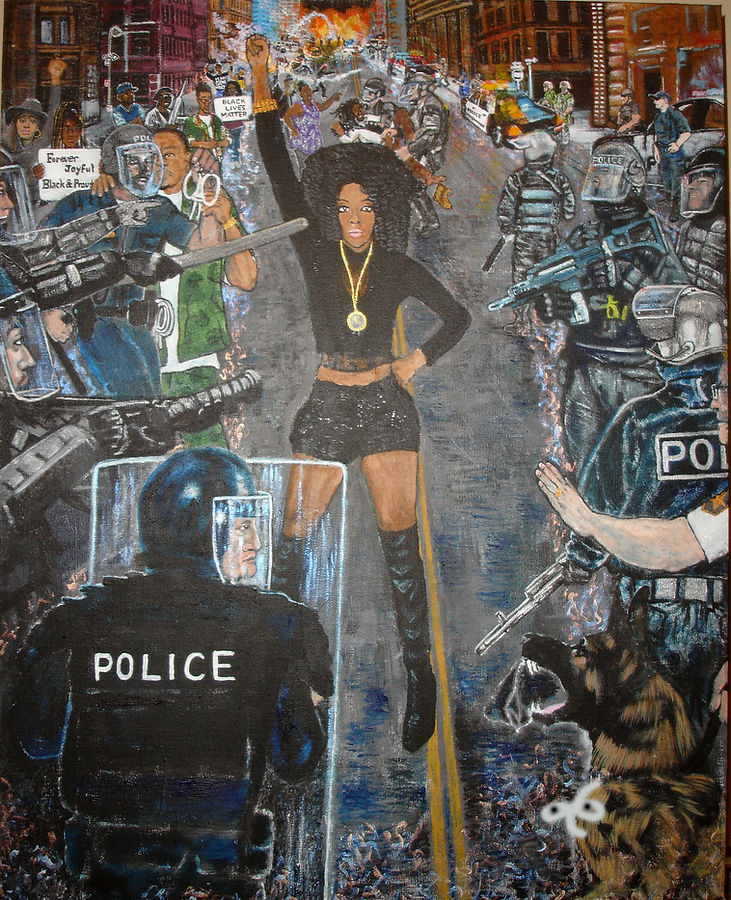
E-Volution
Summary:
Globally, the paradigm of race has emerged as a controlling economic, intellectual, social and spatial force of suppression for African and other indigenous peoples. Race discourse in the Bahamas has been shaped by this global context, resulting in ambivalent identities, historical amnesia and cognitive dissonance in Black and White Bahamians alike. By design, this has resulted in the socio-economic disempowerment of the descendants of the formerly enslaved. Therefore this article argues for a rigourous re-framing of the Bahamian and global race discourse, one marked by historical specificity and indigenous, intersectional intellectual analysis.
About Us
JREVLIB was established in Nassau Bahamas by a cross-sectoral and international group of revolutionary scholars, it is contextualised by an urgent need to provide novel ideas and practical solutions for the economic and social liberation of peoples from the global south.
JREVLIB distinguishes itself through its core tenets of accessibility and availability to the wider public, and its intentionality of purpose for creating and sharing concepts and knowledge related to the pursuit of revolution, liberty and dignity.
In this light, our mission is to facilitate a space for the presentation of revolutionary ideas that can be widely disseminated to the public. The end goal of this mission is to stimulate the organic ingenuity of readers and viewers, as well as our contributing writers, towards the coordinated, informed and evidence-based realisation of true revolutionary change, particularly in the global South.
The material published will be urgent and topical thereby facilitating discussion, debate and decision making for societal transformation.
Submissions are welcomed in a variety of formats (article, art, music, photography, video etc) and subject matters (law, science, history, philosophy, economics, spirituality etc), from both academic and non-academic contributors.
Please contact us at journalofrevolution@gmail.com if you are interested in contributing.
Also please check out the Seshat Public e-Library, where you will find our collection of e-books, and you can even contribute to our collection. Visit Seshat here: